

Purification of biogas and landfill gas Removal of siloxane and hydrogen sulphide using our HELASORP® process
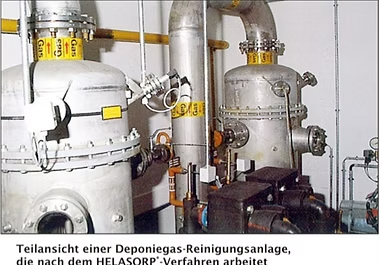
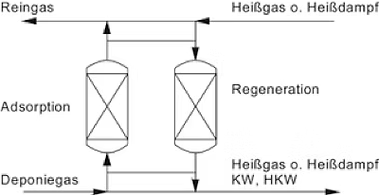
The HELASORP® process was developed specifically for the purification of landfill gas. In this process, all high- and low-molecular-weight organic compounds are removed by absorption. These include:
- chlorinated hydrocarbons
- aromatic hydrocarbons
- organic siloxanes

The advantages of the process: In addition to its reliability, the HELASORP® process is characterized by its resistance to dust, water vapor, oil mist, fluctuations in concentration and mass flow, as well as to sulfur and its compounds.
Efficiency: The HELASORP® process achieves an efficiency of >98% even at low pollutant concentrations. Changes in pollutant concentration or fluctuations in mass flow do not adversely affect the efficiency.
Operating costs: Due to the low temperature of < 90°C in the desorber and the low gas-side pressure drop of < 15 mbar in the absorber, operating costs are extremely low.
Hydrogen sulfide removal: Using a downstream absorber equipped with an iron hydroxide or activated carbon adsorber, sulfur compounds such as hydrogen sulfide (H₂S) can also be removed.
Gas purification
using the Herbst biofilter
The 4 Methods for Hydrogen Sulfide Removal
1. Herbst biofilter for high flow rates, particularly in wastewater treatment plants: With the help of microorganisms (Thiobacillus), H₂S is degraded in the Herbst biofilter on an inorganic support material. This produces sulfurous acid and water. The inorganic media, on which the thiobacilli live, is continuously neutralized with caustic soda. This ensures the desired stable process control. The components inside the Herbst biofilter are wear-free and never need to be replaced.
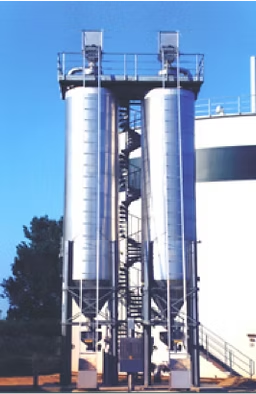
2. In situ H₂S removal: Methanogenic bacteria are sensitive to H₂S, which inhibits biogas production. By using iron hydroxide, H₂S is removed directly in a biogas plant or in the digester. Herbst Umwelttechnik offers complete silo systems for iron hydroxide as well as dosing and suspension reactors, which allow the iron hydroxide to be easily introduced into the process.
3. Adsorptive H₂S removal: To protect the gas engine, H₂S is removed by adsorption prior to combustion. Iron hydroxide is used as the adsorbent. By adding atmospheric oxygen to the adsorber, the iron hydroxide bed is regenerated until the elemental sulfur concentration reaches its maximum value, approximately 300 g S per kilogram of adsorbent. The loaded iron hydroxide is continuously discharged from the adsorber, and the unloaded iron hydroxide is fed in.
4. Compact H₂S adsorber for treating fresh air for building ventilation: Specially developed for the treatment of slightly contaminated fresh air, the small H₂S adsorber can be used to reliably and cost-effectively remove harmful and corrosive hydrogen sulfide, even at low concentrations. Common areas of application include industrial areas, water treatment plants, and biogas facilities, where the surrounding air is often contaminated with hydrogen sulfide. If this air is used for building ventilation, health problems may arise or sensitive electronic components may be damaged.
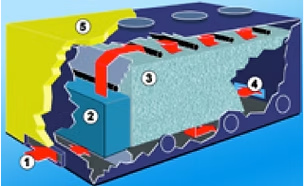
The Herbst Biofilter - Legend
- Raw gas inlet
- Pre-separator
- Biologically active media
- Clean gas outlet
- Housing insulation
Assembly of the autumn biofilter
In the Herbst biofilter, microorganisms colonize a special inorganic HELATORP® carrier material through which the exhaust air to be treated flows. The high efficiency of the Herbst biofilter, combined with its small footprint, is achieved through optimal process control. The growth of microorganisms is promoted by the addition of nutrients. At the same time, internal operating parameters such as colonization density, pH values, nutrient supply, and pollutant load are tailored to each specific case. Despite the intensive biological degradation in the Herbst biofilter, the HELATORP® carrier material does not degrade. In addition to its high degradation capacity, the Herbst biofilter has the advantage over conventional biofilters that the inorganic HELATORP® media never needs to be replaced.
Applications:
- Exhaust gas treatment
- Odor control
- Strip air purification
- Contaminated site remediation
Degradable pollutants:
- Hydrogen sulfide
- Vinyl chloride
- and, to some extent, odors

Deposition of silanes and siloxanes
from the gas phase
The problem: Silanes and siloxanes are silicon-based chemical compounds that are increasingly used in many industrial sectors. Through the waste stream, these various silicon compounds end up in wastewater treatment plants or landfills. In modern waste-to-energy plants, the biogas or landfill gas produced is used to generate electricity via gas engines. During combustion in the gas engine, the siloxanes produce mineral silicon dioxide deposits that cause serious damage. In many cases, this damage calls into question the economic viability of using biogas or landfill gas.

The Solution: Herbst Umwelttechnik GmbH offers several methods for separating siloxane compounds from gases. The selection of the recommended separation method depends on the gas flow rate, the gas composition, and the siloxane concentration.
Our Separation Methods:
- Condensation of siloxanes using gas cooling with a downstream activated carbon reactor
- Adsorptive siloxane separation using iron hydroxide
- Absorptive siloxane separation using our HELASORP® process

